
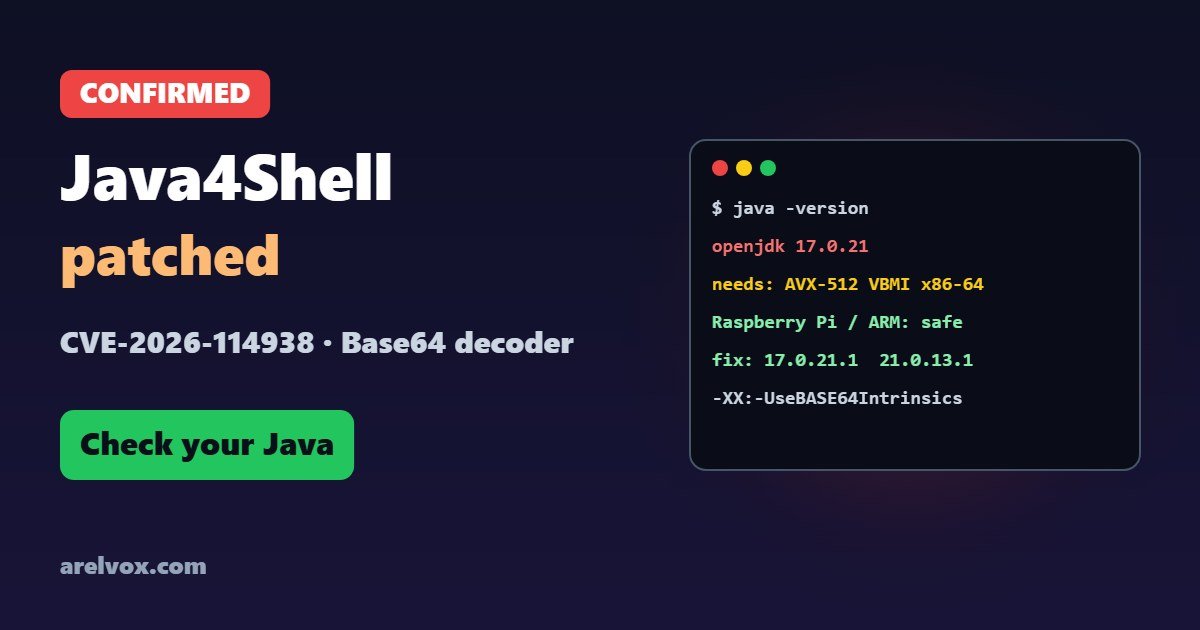
-XX:-UseBASE64Intrinsics.Last updated: November 18, 2026
Yesterday we wrote about Oracle’s November Java update and an unconfirmed OpenJDK bug. Overnight the picture became clear: the OpenJDK Vulnerability Group confirmed the flaw, Oracle shipped fixed builds, and the security firm Calif, which found it, published its technical write-up. The bug now has a name: Java4Shell.
What Java4Shell Is
Java has a fast, CPU-accelerated routine for decoding Base64, the text encoding used for things like login headers, tokens and file uploads. On some Intel and AMD CPUs, invalid Base64 input can make that routine write past its output buffer, corrupting nearby memory before Java rejects the input.
Calif says careful exploitation can leak memory (it calls this part “JavaBleed”, a nod to Heartbleed) or lead to remote code execution. It reports pre-authentication code execution with default settings on Keycloak, Jira, Confluence, JFrog Artifactory, Jenkins and PingFederate, and code execution after login on Kafka, Solr, Elasticsearch and others. Even a Java client that connects to a malicious TLS server can be attacked.
Calif’s researcher Quang Luong found it, and the company says AI played a key role: about an hour to find the bug and two more hours to build a first working exploit.
Who Is Affected
Three things must all be true:
- Java version: OpenJDK 17.0.6 or later, 21, 25 or 27 (any vendor: Oracle, Temurin, Corretto, Zulu, Microsoft, Red Hat…). Java 11 and standard Java 8 are not affected.
- CPU: x86-64 with AVX-512 VBMI: Intel Xeon Ice Lake, Sapphire Rapids, Emerald Rapids, Granite Rapids, or AMD Zen 4 and newer (Ryzen 7000/9000, EPYC 9004). Many cloud VMs qualify.
- Attacker-controlled Base64 must reach Java’s decoder, which happens through everyday features like Basic auth, JWT tokens and uploads.
| Java line | Affected | Fixed (Oracle build) |
|---|---|---|
| 8 | Only Oracle’s 8u511b33-perf build | 8u513-perf |
| 11 | Not affected | – |
| 17 | 17.0.6 to 17.0.21 | 17.0.21.1 |
| 21 | Up to 21.0.13 | 21.0.13.1 |
| 25 | Up to 25.0.5 | 25.0.5.1 |
| 27 | Up to 27.0.1 | 27.0.1.1 |
Good news for makers: Raspberry Pi and other ARM64 boards are not vulnerable, and neither are older Intel desktop CPUs without AVX-512.
1. Check Your CPU
On Linux, all four flags must appear for the bug to be reachable:
grep -m1 '^flags' /proc/cpuinfo | tr ' ' '\n' | grep -E '^(avx512f|avx512bw|avx512vbmi|bmi2)$'No output, or fewer than four lines? Your CPU is not affected, but update Java anyway: Oracle’s update also fixes 10 other flaws.
2. Find Your Java Versions
java -version
update-alternatives --list java

# inside Docker: the container's Java is the one that matters
docker exec -it CONTAINER java -version
Think of Jenkins, Keycloak, Elasticsearch, Minecraft servers and any appliance or container that ships its own Java.
3. Update
Oracle Java users: install the builds ending in .1. For Temurin, Corretto, Zulu and Linux distribution packages, fixed builds are rolling out; Amazon already released Corretto 17.0.21.1.2. Then update containers:
sudo apt update
sudo apt upgrade

docker compose pull
docker compose up -d
4. Can’t Update Yet? Use the JVM Flag
Turning off the accelerated Base64 routine stopped the overflow on every affected version tested:
-XX:-UseBASE64Intrinsics

# Docker Compose example
environment:
  - JAVA_TOOL_OPTIONS=-XX:-UseBASE64Intrinsics
The application must restart, and containers must be recreated, for the flag to apply. Avoid two other flags you may see online: -XX:DisableIntrinsic=_base64_decodeBlock on its own stops the JVM from starting, and -XX:UseAVX=2 breaks Java on ARM hosts.
How Worried Should You Be?
No attacks in the wild have been reported yet, and Java4Shell is not in CISA’s Known Exploited Vulnerabilities list. VulnCheck notes that crashing a vulnerable JVM is easy once you find an entry point, but full code execution needs per-application work, so it does not expect it to be “easily or widely exploitable”. Cisco Talos expects probing to start soon after disclosure. Patch internet-facing Java services first, and keep them behind a firewall or VPN; see our UFW guide and how to check open ports.
Frequently Asked Questions
What is Java4Shell?
Java4Shell is the name for CVE-2026-114938, a heap out-of-bounds write in OpenJDK’s hardware-accelerated Base64 decoder. Invalid Base64 input can make it write past its buffer. Researchers showed it can leak memory and, in some applications, lead to remote code execution without login.
Which Java versions are affected?
OpenJDK 17.0.6 to 17.0.21, 21 up to 21.0.13, 25 up to 25.0.5 and 27 up to 27.0.1, plus Oracle’s Java 8 Performance Pack build. Java 11 and standard Java 8 are not affected. All OpenJDK distributions that carry the code are affected, including Temurin, Corretto, Zulu and Microsoft’s build.
Is my Raspberry Pi affected?
No. The bug needs an x86-64 CPU with AVX-512 VBMI, such as Intel Ice Lake Xeons or AMD Zen 4 and newer. ARM64 systems, including Raspberry Pi, are not vulnerable.
Which versions fix it?
Oracle’s fixed builds end in .1: 17.0.21.1, 21.0.13.1, 25.0.5.1 and 27.0.1.1. Other vendors are rolling out their own fixed builds; check your vendor’s advisory.
Is it being exploited?
As of November 18, no exploitation in the wild has been reported and it is not in CISA’s KEV catalog. Crashing a vulnerable JVM is easy, but full code execution needs per-application work.
Is there a workaround?
Yes. Starting Java with -XX:-UseBASE64Intrinsics stopped the overflow on every affected version researchers tested. You must restart the application for it to take effect.
1 thought on “Java4Shell (CVE-2026-114938) Confirmed and Patched: Who Is Affected and How to Fix It”