Use this free subnet calculator to split any IPv4 address into its network address, broadcast address and usable host range in seconds. Type an IP address, pick a prefix or subnet mask, and the results update instantly. Everything runs in your browser, so it works on desktop and mobile.
IP Subnet Calculator
You can also type CIDR notation, e.g. 10.0.0.5/8
Results
How to Use the Subnet Calculator
- Enter an IPv4 address, for example 192.168.1.10.
- Choose a prefix length from the menu, or type CIDR notation directly, such as 192.168.1.10/24.
- Read the results: network address, broadcast address, host range, masks, IP class and IP type.
Because the subnet calculator refreshes as you type, you can compare different prefix lengths quickly. For example, switch from /24 to /26 and you will see the same network split into four smaller subnets with 62 usable hosts each.
What Is a Subnet?
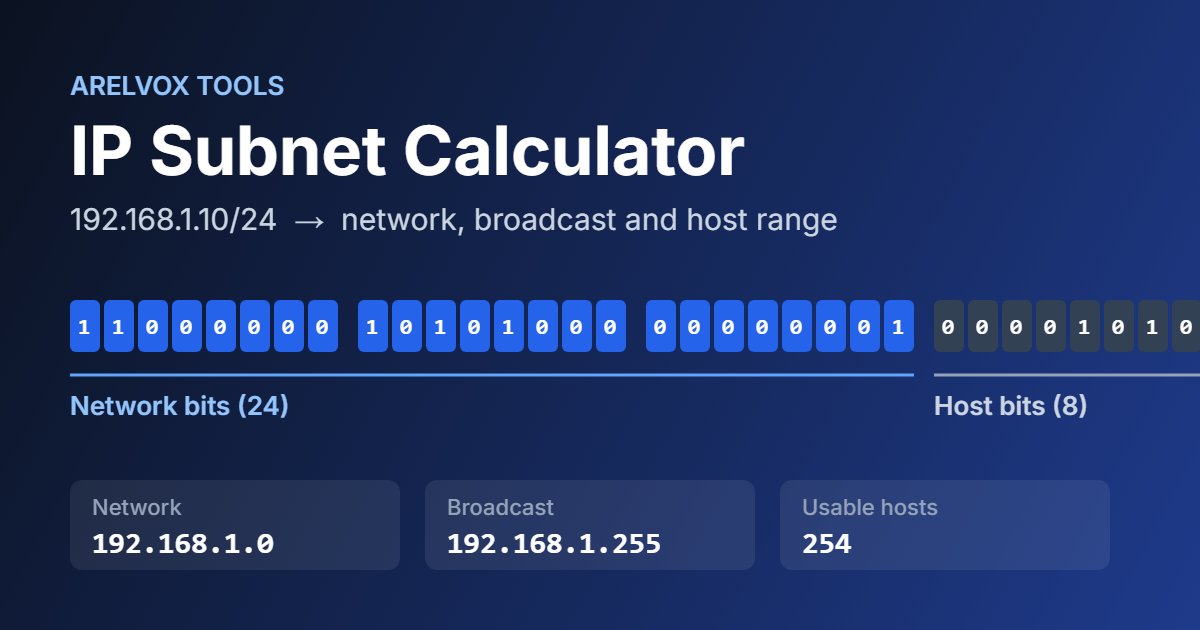
A subnet, short for subnetwork, is a smaller logical part of a larger IP network. Every IPv4 address has 32 bits. The first bits identify the network, while the remaining bits identify individual devices, called hosts. The subnet mask tells routers and computers exactly where that split happens, and a subnet calculator does that math for you.
For instance, in 192.168.1.10/24 the first 24 bits (192.168.1) are the network part, and the last 8 bits identify the host. That leaves 256 addresses in total, exactly what the subnet calculator shows for a /24. If you are new to IP addresses, our guide to your home network, IPs, routers and DNS explains the basics step by step.
Understanding the Subnet Calculator Results
Here is what each line of the subnet calculator output means and when you will need it.
- Network address: the first address of the subnet. It identifies the network itself, so you cannot assign it to a device.
- Broadcast address: the last address. Packets sent to it reach every host in the subnet.
- Usable host range: the addresses the subnet calculator marks as free for computers, phones, printers and servers.
- Subnet mask and wildcard mask: the same prefix written in dotted decimal. Wildcard masks are common in router access lists.
- IP class and IP type: the historical class (A, B or C) and whether the address is private, public, loopback or reserved.
Common Subnet Masks Cheat Sheet
This table shows the subnet sizes you will use most often in home labs, offices and certification exams. You can check any of them with the subnet calculator above.
| Prefix | Subnet mask | Total addresses | Usable hosts |
|---|---|---|---|
| /8 | 255.0.0.0 | 16,777,216 | 16,777,214 |
| /16 | 255.255.0.0 | 65,536 | 65,534 |
| /24 | 255.255.255.0 | 256 | 254 |
| /25 | 255.255.255.128 | 128 | 126 |
| /26 | 255.255.255.192 | 64 | 62 |
| /27 | 255.255.255.224 | 32 | 30 |
| /28 | 255.255.255.240 | 16 | 14 |
| /29 | 255.255.255.248 | 8 | 6 |
| /30 | 255.255.255.252 | 4 | 2 |
| /32 | 255.255.255.255 | 1 | 1 |
How Subnetting Is Calculated
Behind the scenes, the subnet calculator uses simple binary math, which you can also do by hand. First, it converts the IP address and the mask into 32-bit numbers. Next, it applies a bitwise AND to get the network address. Then it sets every host bit to 1 to find the broadcast address. Finally, the usable range sits between those two values.
The number of addresses follows the formula 2 to the power of (32 minus the prefix). Therefore, a /26 gives 64 addresses, and 62 of them are usable after removing the network and broadcast addresses. There are two special cases. A /31 has two usable addresses for point-to-point links, as defined in RFC 3021, and a /32 represents a single host. The subnet calculator handles both cases correctly.
Private IP Address Ranges
In practice, home and office networks normally use the private ranges reserved in RFC 1918: 10.0.0.0/8, 172.16.0.0/12 and 192.168.0.0/16. These addresses are not routed on the public internet, so your router uses NAT to share one public IP. The subnet calculator labels them as Private automatically. Want to protect those devices too? Read our guide on how to secure your home network.
Subnet Calculator FAQ
How many hosts are in a /24 subnet?
A /24 subnet has 256 addresses in total and 254 usable hosts, because the network and broadcast addresses are reserved. Select /24 in the subnet calculator to see it for any IP.
What is the difference between CIDR and a subnet mask?
They describe the same thing in two formats. CIDR notation uses a slash and the number of network bits, such as /24. A subnet mask writes those bits in dotted decimal, such as 255.255.255.0. The subnet calculator accepts both formats.
Is this subnet calculator free?
Yes. It is completely free, needs no sign-up and works in any modern browser. If you work with Linux servers, you may also like our chmod calculator for file permissions.