
If you dug a hole straight down, how far could you get? In 1970, Soviet scientists set out to find out. Twenty years later their drill had gone deeper than anyone before or since. Here is what they found down there, why they stopped, and how it compares with the rest of the planet.
The Numbers
| Kola Superdeep Borehole (SG-3) | |
|---|---|
| Location | Kola Peninsula, northwest Russia, near the Norwegian border |
| Drilling started | 24 May 1970 |
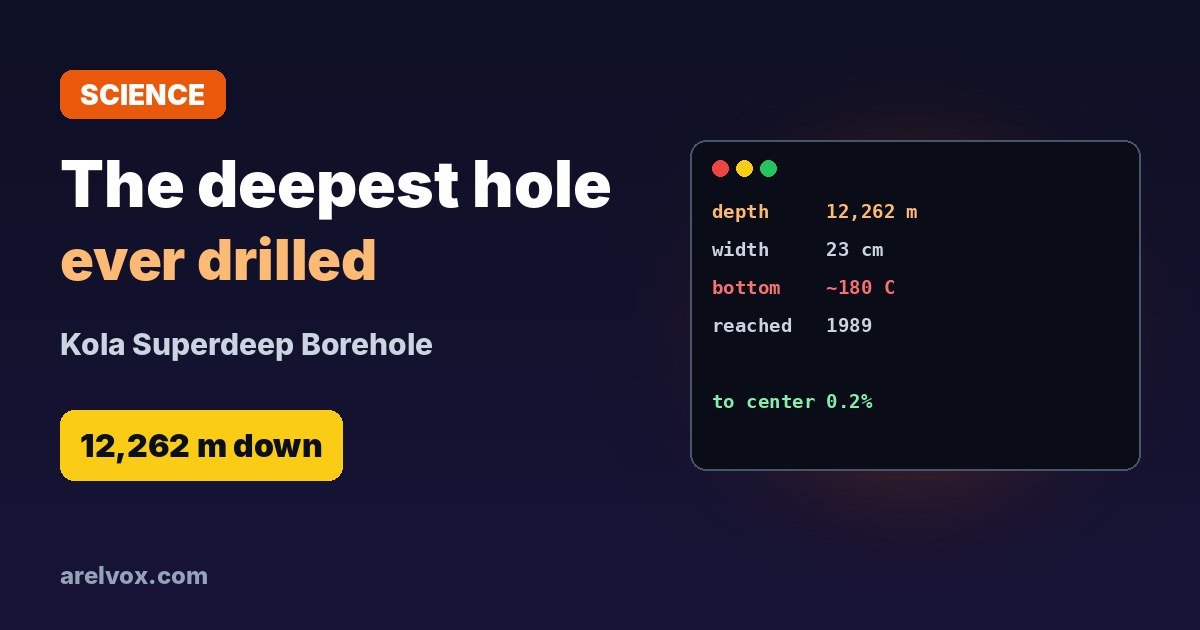
| Deepest point | 12,262 m (about 7.6 miles), reached in 1989 |
| Width | About 23 cm (9 in) |
| Temperature at the bottom | About 180 °C (356 °F) |
| Drilling ended | 1995, for lack of funds |
| Share of the way to Earth’s center | About 0.2% |
How Deep Is 12 km, Really?
- About 15 Burj Khalifas (828 m) stacked on top of each other.
- Deeper than Mount Everest is tall (8,849 m).
- Deeper than the Challenger Deep, the bottom of the ocean (about 11 km).
- But it only scratches the crust: under continents the crust is about 35 km thick, and the center of the Earth is about 6,371 km down.
What They Found Down There
- Water where nobody expected it. Between about 3 and 6 km down there was water that had seeped through the granite and got trapped under impermeable rock.
- Microscopic fossils of plankton about 6 km below the surface.
- No basalt layer. Geologists expected granite to turn into basalt around 7 km. It never did: there was more granite than predicted.
- “Boiling” mud. The drilling mud came back up full of hydrogen gas, so it looked like it was boiling.
Why They Stopped
Heat. Rock gets hotter the deeper you go, but at Kola it got hot faster than models predicted. Near the bottom it reached about 180 °C, much hotter than predicted. At that temperature the rock behaves less like solid stone and more like a thick paste, which makes the hole hard to keep open. The fourth branch of the hole stopped in 1992 because of the heat, and the whole project ended in 1995 when the money ran out. The site was later abandoned and the hole is now sealed with a welded metal cap.
Longer Holes Exist (But They Are Not Deeper)
Oil companies have drilled wells that are longer than Kola. The Al Shaheen well in Qatar, completed in 2008, is 12,289 m long, but it curves sideways under the seabed and goes only about 1,387 m straight down. In a straight line toward the center of the Earth, Kola still holds the record.
The “Well to Hell” Myth
You may have heard that scientists lowered a microphone into the hole and recorded screams. That story is an urban legend. The real findings, water, fossils and boiling mud 12 km down, are strange enough.
Try Digging Deeper Yourself
I liked this story so much that I made a game about it: in CORE DRILL you drill from the surface all the way to the center of the Earth. You pass the Burj Khalifa, Everest, the ocean floor and the Kola Superdeep Borehole, and then keep going through the mantle and the iron core. It is free and runs in your browser.
Frequently Asked Questions
How deep is the Kola Superdeep Borehole?
It reached a true vertical depth of 12,262 metres (about 7.6 miles) in 1989. That is still the deepest point humans have ever drilled into the Earth.
Why did they stop drilling?
The rock near the bottom was much hotter than predicted, about 180 °C, which made drilling extremely difficult. The project also ran out of money in the 1990s and ended in 1995.
How wide is the hole?
Only about 23 cm (9 inches) across. You could not fall into it; today it is sealed with a welded metal cap.
Are there longer holes?
Yes. Some oil wells are longer, like the Al Shaheen well in Qatar at 12,289 m, but they curve sideways. Al Shaheen only goes about 1.4 km straight down. Kola is still the deepest in a straight line.
Is the “well to hell” story true?
No. The story of recorded screams from the bottom of the hole is an urban legend.
How far is it to the center of the Earth?
About 6,371 km. Kola reached roughly 0.2% of that distance.