
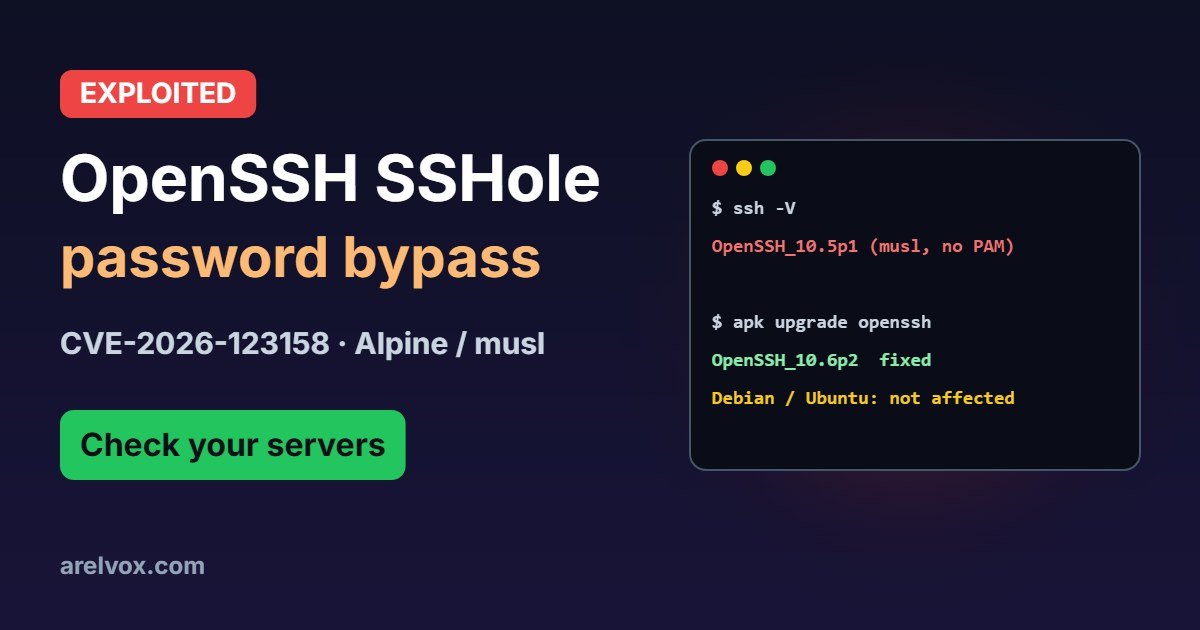
apk upgrade openssh.Last updated: November 17, 2026
“OpenSSH bug exploited” is a headline that makes every self-hoster nervous. The good news: SSHole only hits a specific setup. The bad news: that setup is common in Docker images, routers and small appliances, and attackers started using it two days after the fix came out.
What SSHole Is
When sshd is built without PAM, it checks passwords itself. On systems that use the musl C library instead of glibc, that check can be tricked, so an attacker can sign in to some accounts without knowing the password. OpenSSH developer Damien Miller says the flaw is not in sshd itself, but it can be exploited through sshd. The fix shipped in OpenSSH 10.6p2 on November 5, 2026, and exploit code appeared about four hours later.
Who Is Affected
| System | Status |
|---|---|
| Alpine Linux (default openssh package) | Affected before the fixed package; fixed on every branch from 3.16 to edge |
| Docker images based on Alpine that run sshd | Affected until rebuilt with the fixed package |
| Other musl-based systems built without PAM | Possibly affected; check with your vendor |
| Debian, Ubuntu, Raspberry Pi OS | Not the affected configuration (glibc + PAM) |
| RHEL, Fedora, SUSE | Not affected |
| Accounts that only allow SSH keys | Password bypass does not apply |
Attacks So Far
- November 7: GreyNoise saw the first attempts against its honeypots.
- Attackers ran reconnaissance, queried cloud metadata services and tried to read password hashes and root SSH keys.
- Several added their own key to
authorized_keysto keep access. - One group deployed TAC Agent, a Python remote-control tool; watchTowr also reported botnet and crypto-miner activity.
- CISA added CVE-2026-123158 to its Known Exploited Vulnerabilities catalog.
1. Check Your System
cat /etc/os-release | head -2     # Alpine?
ssh -V                            # OpenSSH version
ldd "$(command -v sshd)" | grep -i musl
sudo sshd -T | grep -iE "usepam|passwordauthentication"
If the OS is Alpine (or ldd shows musl), usepam is no and passwordauthentication is yes, you are in the risky setup. Also check your Docker containers: an Alpine image running its own sshd counts.
2. Update
# Alpine
apk update
apk upgrade openssh
rc-service sshd restart

# Docker images: rebuild from a fresh base image
docker compose build --pull
docker compose up -d
Installing the package is not enough on its own: restart sshd so the new binary is running.
3. Can’t Update Yet? Turn Off Passwords
Use key-only logins. Our guide on setting up SSH keys takes five minutes. Then in /etc/ssh/sshd_config:
PasswordAuthentication no
KbdInteractiveAuthentication no
Restart sshd and test in a second terminal before you close the first one. Better still, don’t expose SSH to the whole internet: allow it only from your LAN with UFW or reach your server through a VPN.
4. Look for Signs of a Break-In
cat ~/.ssh/authorized_keys /root/.ssh/authorized_keys   # unknown keys?
last -a | head -20                                     # recent logins
ps aux --sort=-%cpu | head                             # miners eat CPU
If you find a key you did not add, assume the box is compromised: rotate passwords and keys, and rebuild if you can.
Frequently Asked Questions
What is SSHole?
SSHole is the nickname for CVE-2026-123158, a password-check bypass in OpenSSH’s server (sshd). On affected systems an attacker can log in to some accounts over SSH without a valid password. It has a CVSS score of 8.1.
Which systems are affected?
Only Linux systems where sshd is built against the musl C library without PAM, with password authentication enabled. Alpine Linux’s default openssh package is the main example. Debian, Ubuntu, Raspberry Pi OS, RHEL and SUSE use glibc and PAM and are not in the affected configuration.
Is it being exploited?
Yes. GreyNoise saw the first attacks on November 7, 2026, and CISA added the flaw to its Known Exploited Vulnerabilities catalog. Attackers have read password hashes and SSH keys, added their own keys to authorized_keys, installed a remote access agent and run cryptocurrency miners.
Which version fixes it?
OpenSSH 10.6p2, released on November 5, 2026. Alpine shipped fixed packages for every branch from 3.16 to edge; run apk upgrade openssh and restart sshd.
What if I cannot update right now?
Disable password logins with PasswordAuthentication no and use SSH keys only, or stop exposing SSH to the internet. Then update as soon as you can.