
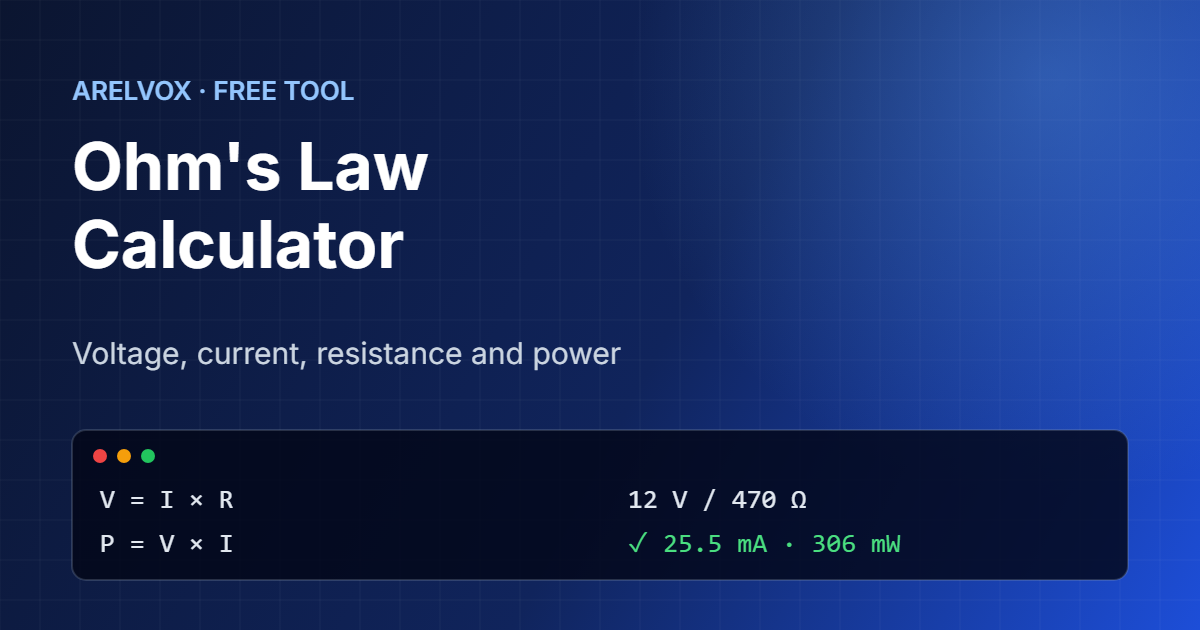
Use this free Ohm’s law calculator to find voltage, current, resistance or power in seconds. Enter any two values, choose the units, and the calculator works out the other two and shows the formulas it used.
Ohm’s Law Calculator
Enter any two values. The calculator finds the other two.
Results
How to Use the Ohm's Law Calculator
- First, type any two known values, for example the voltage of your power supply and the value of your resistor.
- Then, choose the right unit for each value, such as mA for current or kΩ for resistance.
- Next, press Calculate (or Enter). The two missing values appear in the results, together with the formulas.
- Finally, press Clear to start a new calculation with a different pair of values.
What Is Ohm's Law?
Ohm's law describes how voltage, current and resistance relate in an electrical circuit. In short, the current through a resistor equals the voltage across it divided by its resistance. Therefore, if you know two of the three values, you can always find the third. Our Ohm's law calculator does exactly that, and it also adds power, which is just as important when you choose parts.
V = I × R      (voltage = current × resistance)
I = V / R      (current = voltage / resistance)
R = V / I      (resistance = voltage / current)
For example, a 470 Ω resistor connected to 12 V lets 12 / 470 = 0.0255 A flow, which is about 25.5 mA.
The Power Formulas
Power tells you how much energy a part turns into heat every second. As a result, it decides which resistor rating you need. The basic formula is P = V × I, and by combining it with Ohm's law you get two more versions:
P = V × I
P = I² × R
P = V² / R
In the example above, the resistor turns 12 × 0.0255 = 0.306 W into heat. Because a common 1/4 W resistor would run too hot, you should pick a 1/2 W part instead. As a rule of thumb, choose a resistor rated for at least twice the power the calculator shows.
Common Examples
- LED current: 3 V across a 150 Ω resistor gives 20 mA. For a full calculation, use our LED resistor calculator.
- Heater element: a 2,000 W heater on 230 V draws about 8.7 A and has a resistance of about 26 Ω.
- USB power: a device using 500 mA at 5 V consumes 2.5 W.
- Pull-up resistor: 3.3 V across 10 kΩ lets only 0.33 mA flow, which is why pull-ups waste almost no power.
If you are not sure about a resistor's value, read its bands with our resistor color code calculator first.
Units and Prefixes
Typically, small circuits use milliamps and kilohms, while mains devices use amps and watts. The Ohm's law calculator handles the conversion for you, so 25 mA and 0.025 A give exactly the same result. In addition, results are shown with the most readable prefix, such as µW, mW, W or kW.
In practice, Ohm's law was first published by Georg Ohm in 1827, and it is still the starting point for almost every circuit you build. If you want the full history and the theory behind it, the Wikipedia article on Ohm's law is a good next step. Meanwhile, for quick everyday answers, the Ohm's law calculator above is all you need.
Frequently Asked Questions
What is the formula for Ohm's law?
In short, Ohm's law is V = I × R, where V is voltage in volts, I is current in amps and R is resistance in ohms. You can rearrange it to I = V / R or R = V / I.
Can I calculate power with this calculator?
Yes. Enter any two of voltage, current, resistance and power, and the calculator finds the other two using P = V × I, P = I² × R or P = V² / R.
Why does my measured current differ from the result?
That is because real parts have tolerances, batteries sag under load and wires add a little resistance. For example, a resistor with a gold band can be 5% higher or lower than its marked value.
Does Ohm's law work for LEDs and motors?
Not directly. LEDs, diodes and motors are not simple resistors, so their current does not rise in a straight line with voltage. However, you can still use Ohm's law for the resistor in series with an LED.
Is this Ohm's law calculator free?
Yes. In fact, it is completely free, needs no sign-up and runs in your browser.
More free tools: LED resistor calculator, resistor color code calculator and the full list on our Projects page.