
I make browser idle games: SILICON TYCOON, SPARKMIND and a few more. The hardest part is not the code, it is the pacing. Is the second building too far away? Does prestige come too late? You can’t answer that by playing for an afternoon after every change, so I let a bot do it.
The Bot: 30 Lines That Play for 6 Hours
The idea is simple. Every simulated second the bot earns income, then buys whatever gives the most income per coin, and buys any upgrade it can afford. It also clicks for the first 5 minutes, like a real player at the start. It logs the moment each building is first bought and when prestige becomes available.
let t = 0;
while (t < 6 * 3600) {
  const click = t < 300 ? 4 : 0;          // 4 clicks/s for the first 5 min
  earn((rate() + click) * 1); t += 1;
  for (;;) {                               // buy until broke
    let best = null, bestValue = 0;
    for (const g of visibleGenerators()) {
      const value = incomeOf(g) / costOf(g); // income per coin
      if (costOf(g) > money) continue;
      if (value > bestValue) { best = g; bestValue = value; }
    }
    const up = affordableUpgrade();
    if (up) { buy(up); continue; }
    if (!best) break;
    buy(best);
  }
  logFirsts(t);                             // first rig, first prestige...
}
It is greedy and perfect, so it is faster than a human. I use its times as the best case and expect real players to be roughly 1.5 to 2 times slower.
Experiment 1: Income Speed
The first version of my template’s demo, Star Miner, felt slow. The bot confirmed it: the second building took 6 minutes. I doubled the base income of every building and ran it again.
| Milestone | Base income ×1 | Base income ×2 |
|---|---|---|
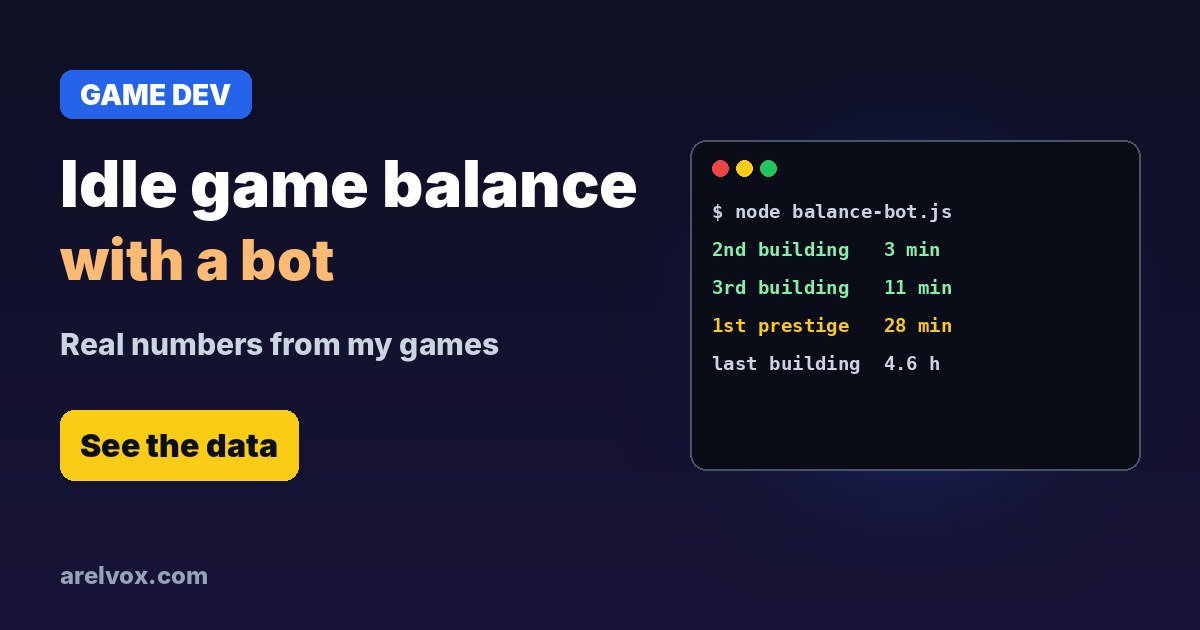
| 2nd building | 6 min | 3 min |
| 3rd building | 22 min | 11 min |
| 4th building | 41 min | 21 min |
| First prestige | 56 min | 28 min |
| Prestige worth 10 points | 161 min | 80 min |
| Last building | not reached in 6 h | 4.6 h |
Six minutes for the second building is where people close the tab. Three minutes keeps them. Doubling income halved every milestone, which makes sense since everything scales with income, and it was the single most important change.
Experiment 2: Cost Growth
Every idle game uses a cost formula like cost = base × growth^owned. The genre standard is 1.15. I tested three values with everything else identical.
| Cost growth | First prestige | Last building | Drones owned after 6 h |
|---|---|---|---|
| 1.10 | 21 min | 3.3 h | 200 |
| 1.15 | 28 min | 4.6 h | 129 |
| 1.20 | 33 min | 5.4 h | 95 |
Two things surprised me. First, the early game barely changes: the second building appears at 3–4 minutes in all three cases. Cost growth mostly matters in the mid and late game. Second, with 1.10 the bot ends up owning 200 of the first building, which makes the numbers feel cheap. I kept 1.15 and tune pacing with income and unlock thresholds instead.
What I Learned
- Fix the first 3 minutes first. Getting the second building within 2–3 minutes matters more than any late-game tweak.
- Put a cheap ×2 upgrade right after each new building. Buying the building then feels twice as rewarding.
- Aim the first prestige at 20–40 minutes and make it worth at least +10–20% income, or nobody understands why they should reset.
- Use a bot for pacing, humans for fun. The bot tells you when things happen, not whether they feel good. Both matter.
- For big games, check the late game with a model. In SILICON TYCOON the bot plays the real engine for the first hour, where my test runs reached the Megafab era in about 25–32 minutes, and a simpler spreadsheet-style model checks the 10-hour late game.
Try It Yourself
The demo I used for these tests is free to play: Star Miner on itch.io. If you want to make your own idle game, I packaged its engine as IDLE FORGE, a plain-JavaScript template where you edit one config file. The balancing numbers in this article are its defaults.
Frequently Asked Questions
What is a good cost growth for an idle game?
Around 1.15 per purchase, meaning each building costs 15% more than the last. In my simulations 1.10 brought the last building forward from 4.6 to 3.3 hours, and 1.20 pushed it back to 5.4 hours. 1.15 is a good default and you tune pacing with income and unlock thresholds instead.
When should the first prestige happen?
In my games I aim for 20 to 40 minutes. In the IDLE FORGE demo it lands at about 28 minutes. Earlier and it feels pointless, later and many players quit before they discover it.
How do you test balance without playing for hours?
I write a small bot that plays the game at high speed: every simulated second it buys whatever gives the most income per coin spent. It plays 6 hours in under a second and logs when each building and prestige happens.
Does the bot play like a real player?
No. It is greedy and never forgets to buy, so real players are slower. I treat its times as a lower bound and expect real players to take about 1.5 to 2 times longer.