
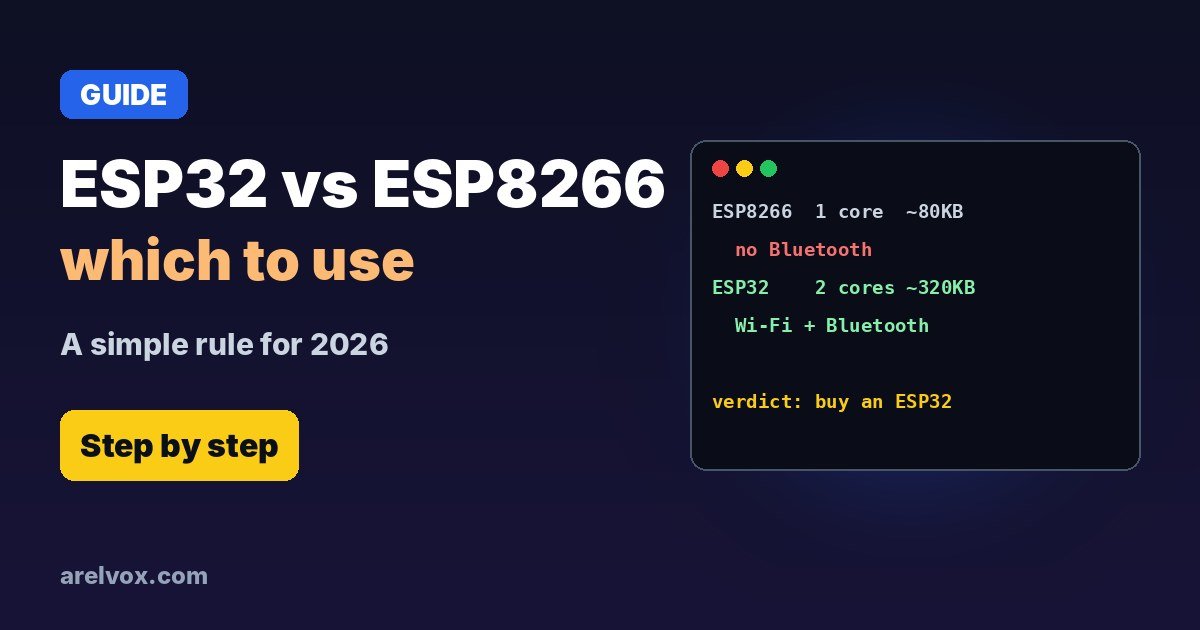
The ESP8266 started the cheap Wi-Fi microcontroller revolution, and the ESP32 is its bigger successor. Both are made by Espressif, both run Arduino, ESPHome and MicroPython, and both cost a few euros. So which one should you use? Here is a clear comparison and a simple rule.
Side-by-Side Comparison
| ESP8266 | ESP32 (classic) | |
|---|---|---|
| CPU | 1 core, 80/160 MHz | 2 cores, up to 240 MHz |
| RAM | ~80 KB data RAM | ~320 KB |
| Wi-Fi | 2.4 GHz b/g/n | 2.4 GHz b/g/n |
| Bluetooth | No | Classic + BLE |
| Usable GPIO | ~11 | ~25+ |
| Analog inputs (ADC) | 1 (0–1 V on the chip) | Up to 18 channels |
| Touch pins | No | Yes (10) |
| DAC | No | 2 channels |
| Hardware PWM | Software | 16 channels |
| Typical dev board | NodeMCU, Wemos D1 Mini | ESP32 DevKit V1 / DevKitC |
🛒 What you need
As an Amazon Associate, Arelvox earns from qualifying purchases. This does not change the price you pay.
When the ESP32 Wins
- You need Bluetooth: BLE sensors, presence detection, a Bluetooth proxy for Home Assistant.
- You need more pins: displays, multiple sensors, buttons and LEDs at the same time.
- You read analog sensors: the ESP8266 has a single ADC; the ESP32 has many.
- You run heavier code: web servers, TLS, JSON, audio, displays. The extra RAM and second core make a huge difference.
If you go with an ESP32, check which ESP32 pins are safe to use before wiring, because a few pins can stop it from booting.
When the ESP8266 Is Still Fine
- A single temperature or door sensor that reports over Wi-Fi.
- A relay or smart plug controlled by ESPHome or Tasmota.
- You already have several and the project is simple.
My Rule of Thumb
If you are buying today, buy an ESP32. The price difference is small and the extra headroom saves you from redesigning the project later. Start with ESPHome if you use Home Assistant: here is how to install ESPHome on Windows, and if the board does not show up, how to fix the ESP32 not detected error.
Frequently Asked Questions
Is the ESP8266 obsolete?
Not obsolete, but for new projects the ESP32 family is usually the better choice. It costs about the same, has Bluetooth, more pins, more memory and a second CPU core. The ESP8266 still makes sense for very simple Wi-Fi sensors or if you already have a drawer full of them.
Can I use the same code on both?
Mostly, if you use the Arduino framework or ESPHome. The Wi-Fi libraries have slightly different names (ESP8266WiFi.h vs WiFi.h) and pin numbers differ, but the logic of most sketches carries over with small changes.
Which uses less power?
In deep sleep both can reach very low currents on good boards. The real difference is usually the board: cheap dev boards with power LEDs and USB chips waste far more than the chip itself.
Which ESP32 should a beginner buy?
A classic ESP32 DevKit (WROOM-32). Almost every tutorial uses it. If you need a camera or lots of RAM, look at the ESP32-S3; for tiny low-power projects, the ESP32-C3.