
A large language model is the technology behind chatbots, writing assistants, and code helpers that have become part of everyday life. But what is it really, and how can a program write text that sounds human? In this guide, you’ll learn what a large language model is, how it works, and what it can and cannot do, without any complicated math.
In this guide
- What Is a Large Language Model?
- How Does a Large Language Model Work?
- How Is a Large Language Model Trained?
- What Can a Large Language Model Do?
- Limitations of a Large Language Model
- Can You Run a Large Language Model at Home?
- Tips for Getting Better Answers from a Large Language Model
- Conclusion: Understanding the Large Language Model
What Is a Large Language Model?
A large language model (LLM) is a type of artificial intelligence trained on huge amounts of text, such as books, articles, websites, and code. By studying patterns in all that text, it learns how language works: which words tend to follow others, how sentences are built, and how ideas connect.
The word “large” refers to two things: the amount of data used for training and the number of parameters, the internal values the model adjusts while it learns. Modern models have billions of them.
How Does a Large Language Model Work?

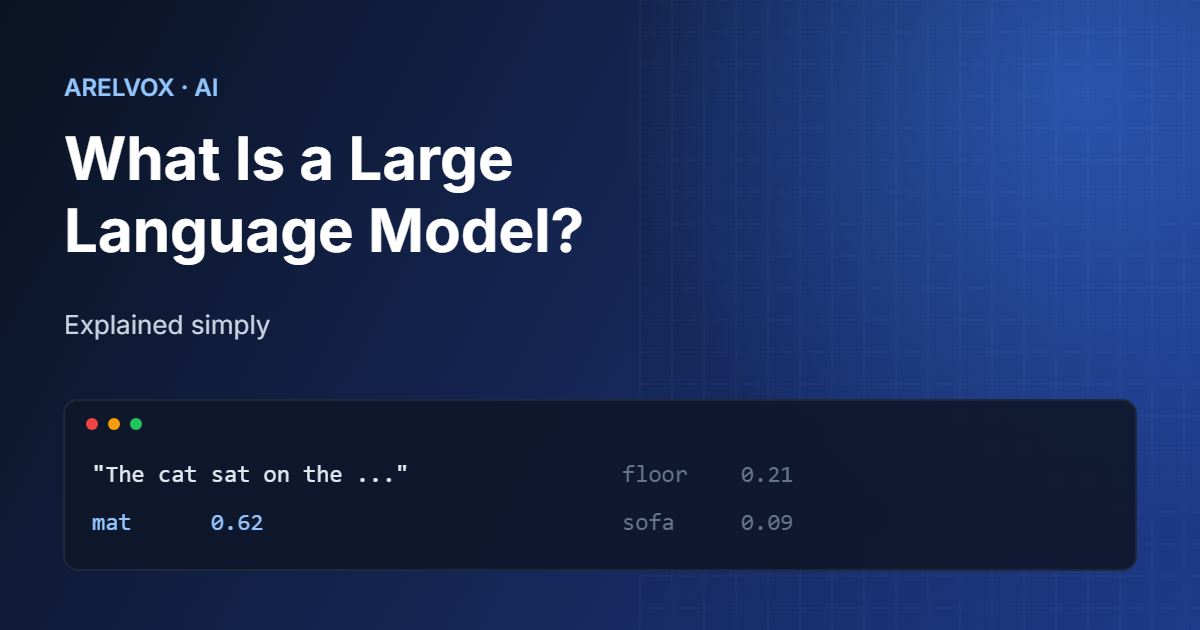
At its core, a large language model does one simple thing: it predicts the next piece of text. Given the words “The capital of France is”, it calculates which word is most likely to come next, and “Paris” scores very high.
By repeating this prediction again and again, one word after another, the model can produce full sentences, paragraphs, and even working code.
Tokens: How the Model Reads Text
Models don’t read whole words the way we do. They split text into small units called tokens, which can be a word, part of a word, or even a single character. Everything the model reads and writes is measured in tokens, and every model has a limit on how many it can handle at once. We call this limit the context window.
The Transformer Architecture
Most modern models use an architecture called the transformer, introduced in 2017 in a research paper called Attention Is All You Need. Its key idea, attention, lets the model weigh which words in a sentence matter most for understanding the others. That is how a large language model can keep track of context across long passages.
How Is a Large Language Model Trained?
Training usually happens in two main stages:
- Pre-training: The model reads enormous amounts of text and learns to predict the next token. This stage requires powerful hardware and a lot of time and energy.
- Fine-tuning: The model is then refined with more specific examples and human feedback, so it follows instructions, answers helpfully, and avoids harmful content.
After training, the model doesn’t “look up” answers in a database. It generates them from the patterns it learned.
What Can a Large Language Model Do?
A large language model is surprisingly versatile. Common uses include:
- Writing and editing text, from emails to articles
- Summarizing long documents
- Translating between languages
- Explaining difficult concepts in simple terms
- Writing, explaining, and debugging code
- Answering questions and brainstorming ideas
If you’re learning to program, an LLM can be a helpful tutor. For example, it can explain commands from our guide to essential Linux commands line by line.
Limitations of a Large Language Model
Despite how impressive it sounds, a large language model has real weaknesses you should know about:
- Hallucinations: It can produce answers that sound confident but are false or invented. Always verify important facts.
- No real understanding: It works with statistical patterns, not human-like comprehension.
- Outdated knowledge: Its knowledge stops at the end of its training data unless it can search the web.
- Bias: It can reflect biases present in the text it learned from.
- Privacy: Anything you type into an online service may be stored or processed. Never share passwords or sensitive personal data.
Can You Run a Large Language Model at Home?

Yes, to a degree. Smaller open-source models can run on a normal computer, and tools like Ollama make it easy to try them locally. Running a model on your own machine keeps your data private, though it needs a decent amount of memory. If you enjoy home labs, you could also explore what your own hardware can do, starting with our Raspberry Pi home server guide.
Tips for Getting Better Answers from a Large Language Model
- Be specific. Explain what you want, who the audience is, and what format you need.
- Give context. Include relevant details instead of short, vague questions.
- Ask for steps. For complex problems, ask the model to work through them one step at a time.
- Check the result. Treat the answer as a draft, not as a guaranteed fact.
Conclusion: Understanding the Large Language Model
A large language model is a powerful tool that predicts text based on patterns learned from huge amounts of data. It can save you time, help you learn, and spark ideas, but it works best when you understand its limits and double-check what it tells you.
Now that you know how a large language model works, try one with a real task: summarize an article, explain a concept, or debug a small script, and see how it performs.
Have a topic you’d like us to cover in the AI category? Let us know through the Contact page.
Keep reading: if you want to experiment with local models, you will spend a lot of time in the terminal. Our free Linux command generator builds common commands for you, and Git basics helps you keep your experiments under version control.