
Typing faster saves real time. If you type for two hours a day at 35 words per minute, reaching 60 WPM gives you back roughly 45 minutes daily. The good news is that typing speed is a skill, not a talent. These are the habits that actually raise your WPM, in the order that works best.
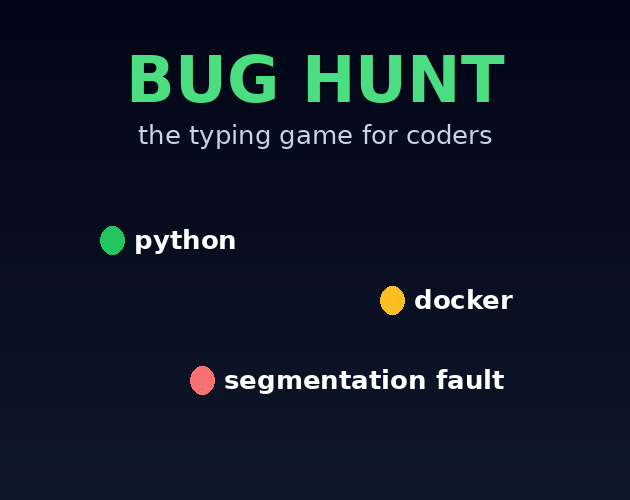
Practise while you learn: squash falling bugs by typing their words before they reach your code.
Play Bug Hunt (free typing game)1. Measure Your Current Speed
Before changing anything, take two or three one-minute typing tests and write down your WPM and accuracy. This gives you a baseline, so you can see progress later. Most people are surprised that their accuracy is lower than they thought.
2. Learn the Home Row Position
Rest your left fingers on A S D F and your right fingers on J K L ;. The small bumps on F and J let you find the position without looking. Your thumbs rest on the space bar. From here, each finger is responsible for its own column of keys.
| Finger | Keys (left hand / right hand) |
|---|---|
| Index | R T F G V B / Y U H J N M |
| Middle | E D C / I K , |
| Ring | W S X / O L . |
| Little | Q A Z / P ; / |
| Thumbs | Space bar |
3. Stop Looking at the Keyboard
This is the hardest step and the most important one. Looking down breaks your rhythm and caps your speed. At first you will type slower, often around 15 to 20 WPM. That is normal. Within one or two weeks, your fingers start finding keys on their own and the speed comes back, this time with no ceiling.
4. Slow Down to Speed Up
Every typo costs you a backspace, a retype and a moment of lost focus. So aim for 96% accuracy or more and only then push your speed. A good rhythm is steady and even, like a metronome, rather than fast bursts followed by corrections.
5. Practise a Little Every Day
Ten to fifteen focused minutes a day beat a two-hour session once a week, because your brain consolidates motor skills between sessions. Split the time like this:
- 3 minutes warming up with the home row and common letter pairs (th, he, in, er).
- 5 to 7 minutes typing real sentences or a short text.
- 3 to 5 minutes on a typing game, to practise under pressure.
6. Practise Your Weak Keys
Most typing sites show which keys slow you down. Common trouble spots are numbers, the top row and keys reached by the little fingers. Spend a few minutes on drills for those keys, and your average speed rises quickly.
7. Use Typing Games to Stay Motivated
The biggest reason people stop improving is that practice gets boring. Typing games fix that, as long as they reward accuracy rather than random mashing. In Bug Hunt, for example, typing words without mistakes builds a combo multiplier up to x5, and every five levels a boss phrase tests your accuracy under pressure.
8. Fix Your Posture and Setup
- Sit with your feet flat and your elbows at roughly 90 degrees.
- Keep your wrists straight and floating, not resting on the desk while you type.
- Place the screen at eye level, so you do not need to look down.
- Take short breaks to avoid strain, especially during long practice sessions.
Typing Speed Benchmarks
| WPM | Level |
|---|---|
| Under 30 | Beginner |
| 30 to 45 | Average |
| 45 to 65 | Good |
| 65 to 80 | Fast |
| 80+ | Very fast / professional |
Frequently Asked Questions
What is a good typing speed?
The average adult types around 40 words per minute. 60 WPM is good for most office work, and 80 WPM or more is fast. Accuracy above 95% matters as much as speed.
How long does it take to type faster?
With 10 to 15 minutes of focused practice a day, most people notice a clear improvement in two to four weeks. Learning touch typing from scratch usually takes one to two months before you are faster than before.
Is touch typing really faster?
Yes, in the long run. Typing with two or four fingers can feel fast, but it tops out early because you have to look at the keyboard. Touch typists can keep their eyes on the screen and keep improving.
Does a mechanical keyboard make you type faster?
Not by itself. A comfortable keyboard can help you practise longer, but technique and practice matter far more than the switches.
Are typing games good practice?
Yes, if they reward accuracy. Games keep practice fun, so you do it more often. Mix them with plain exercises that use real sentences.
How many bugs can you squash? Free, no download, works on desktop and mobile.
Play Bug HuntMore free games: 2048, Sky Stack and the rest of our free browser games.