
Last updated: November 11, 2026
Patch Tuesday is huge again: for the second month in a row Microsoft fixed more than 1,000 security flaws. Counts vary by source (SecurityWeek says 1,094, BleepingComputer 1,235, The Hacker News 1,259) because some include third-party and Chromium CVEs. Most can wait for your normal update cycle. One cannot: an Outlook bug that criminals are already using to steal Windows credentials.
The Outlook Zero-Day (CVE-2026-124194)
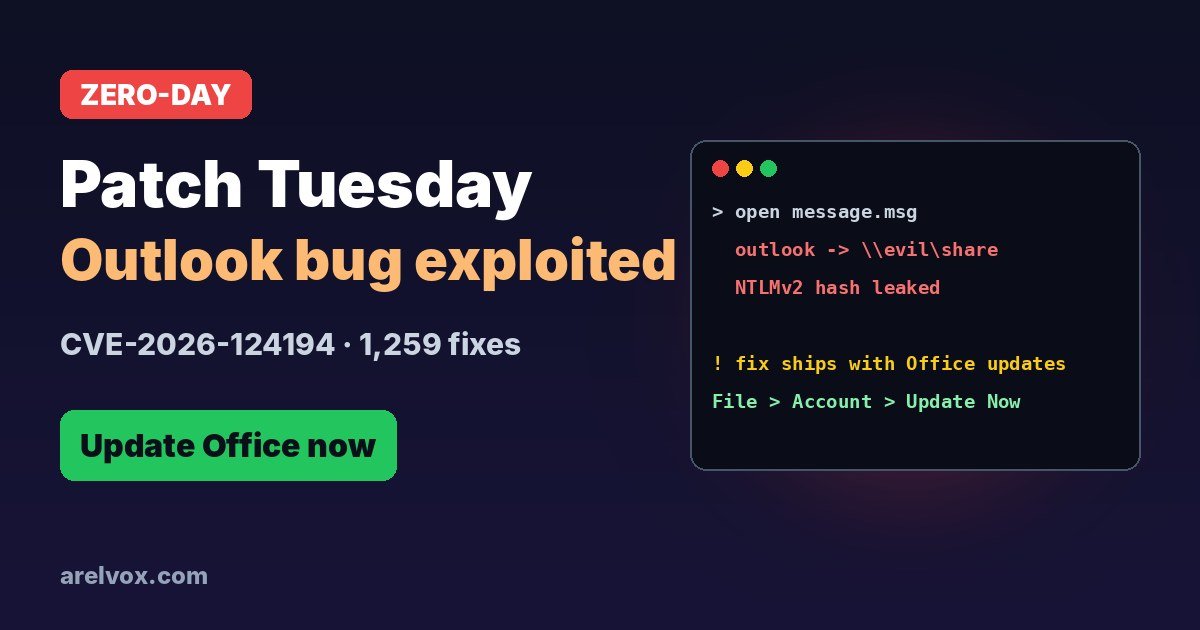
Outlook normally warns you before a message loads content from the internet. This bug skips that warning. An attacker sends a specially crafted message file; if the victim opens it, Outlook quietly connects to a server the attacker controls.
That connection is the whole point. When Windows talks to a network share it tries to log in automatically, and in doing so it can hand over the user’s NTLMv2 hash. Attackers can crack the hash offline or relay it to sign in elsewhere as the victim.
- Rating: Moderate, CVSS 6.5. Security vendors say that label undersells it, because it is exploited and needs only one click.
- Needs: network access and the victim opening the file.
- Found by: a researcher known as Nono and Benoît Sevens of Anthropic, using Claude.
- Who is behind the attacks: Microsoft has not said.
The Numbers
| Area | Fixes |
|---|---|
| Total CVEs | 1,094 to 1,259 depending on the source (second month over 1,000) |
| Windows | 726 |
| Office | 174 |
| SQL Server | 59 |
| SharePoint Server | 27 |
| Elevation of privilege | More than 500 |
| Exploited zero-days | 1 (Outlook) |
Other bugs worth knowing: a critical Windows Search flaw (CVE-2026-116928, CVSS 9.8) that Microsoft says could be triggered by a malicious attachment indexed by Exchange Server, maybe without anyone opening it. There are also critical remote code execution fixes in LDAP (CVE-2026-119958), Schannel (CVE-2026-119952) and the Virtual Filtering Platform (CVE-2026-95962). None of these is known to be exploited yet.
How to Update
1. Update Office. This is the step people miss. Open Word or Outlook, go to File > Account (Office Account in Outlook), then Update Options > Update Now. If you only see “Enable Updates”, click it first. On a work PC your IT team may push this for you.
2. Update Windows. Go to Settings > Windows Update > Check for updates, install everything, restart, and check again until it says you are up to date.
3. Admins: patch internet-facing servers and Exchange first, then the exploited Outlook bug on every client, then the rest. You can also reduce NTLM exposure in general by blocking outbound SMB (TCP 445) at the firewall and adding sensitive accounts to the Protected Users group.
# PowerShell: check installed Office build (Click-to-Run)
Get-ItemProperty HKLM:\SOFTWARE\Microsoft\Office\ClickToRun\Configuration | Select VersionToReport
Why This Keeps Happening
NTLM hash leaks through Outlook are an old trick: any feature that makes Windows reach out to a remote server can hand over credentials. Microsoft is slowly retiring NTLM, but until it is gone, bugs like this stay valuable to attackers. It is also another bug found with the help of AI, which is becoming normal across Windows, Linux and hypervisors alike.
Frequently Asked Questions
What is the Outlook zero-day patched in November 2026?
CVE-2026-124194, a flaw in Microsoft Outlook that attackers are already exploiting. If you open a specially crafted message file, Outlook connects to an attacker-controlled server without showing its usual external-content warning, which can leak your NTLMv2 password hash.
Is it enough to run Windows Update?
No. The Outlook fix ships through Office updates, so you also need to update Office (File > Account > Update Options > Update Now). Run Windows Update as well for the rest of the fixes.
How many vulnerabilities did Microsoft fix?
The Hacker News counts 1,259 CVEs, the second month in a row above 1,000. More than 500 are elevation of privilege bugs. 165 of the IDs are for non-Microsoft components.
What is an NTLMv2 hash and why does it matter?
It is a value derived from your Windows password that Windows sends to prove who you are. An attacker who captures it can try to crack it offline or relay it to sign in to other services as you.
Which other bugs should I worry about?
CVE-2026-116928, a critical remote code execution flaw in Windows Search (CVSS 9.8). Microsoft says a malicious attachment indexed by Exchange Server could trigger it, possibly without anyone opening it. It is not known to be exploited yet.
1 thought on “Microsoft November 2026 Patch Tuesday: Outlook Zero-Day Leaks Your NTLM Hash. Update Office Now”