
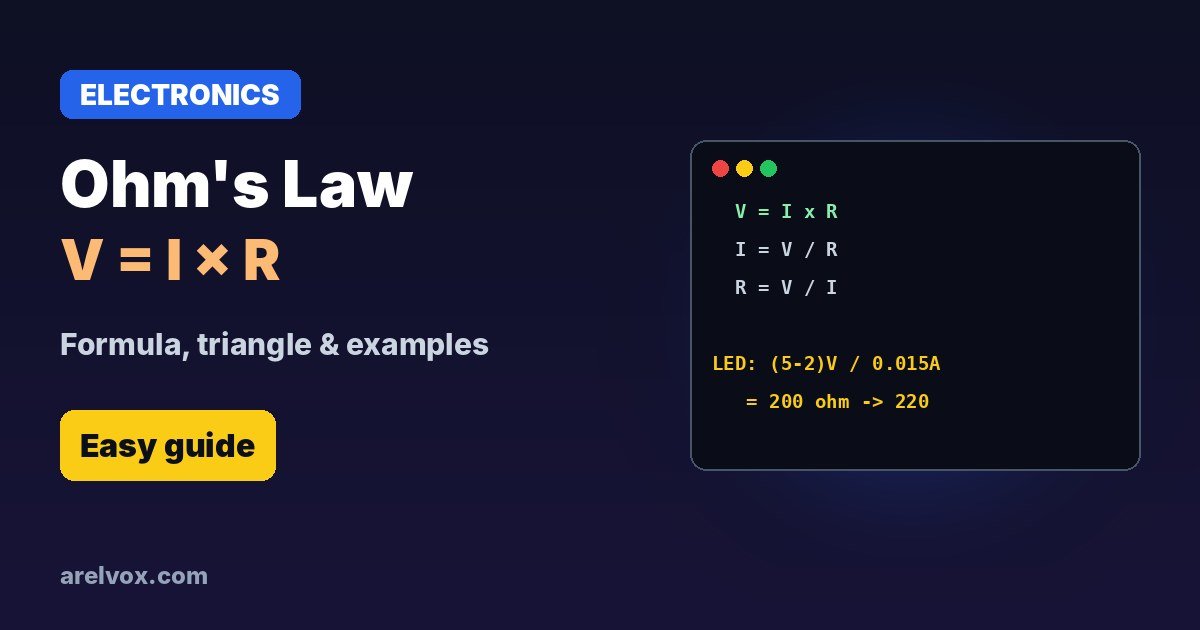
Ohm’s law is the single most useful formula in electronics. Whether you are picking a resistor for an LED, checking if a power supply is big enough or debugging an ESP32 project, you will use it. Here is how it works, with simple examples you can follow without a physics degree.
The Ohm’s Law Formula
Ohm’s law links three values in a circuit:
- Voltage (V), measured in volts: the electrical “pressure” pushing current through the circuit.
- Current (I), measured in amperes (amps): how much electricity flows.
- Resistance (R), measured in ohms (Ω): how much the component resists that flow.
The relationship is V = I × R. A useful way to picture it is water in a pipe: voltage is the water pressure, current is how much water flows, and resistance is how narrow the pipe is. More pressure means more flow; a narrower pipe means less.
| You want | Formula | Example |
|---|---|---|
| Voltage | V = I × R | 0.02 A × 220 Ω = 4.4 V |
| Current | I = V / R | 5 V / 1000 Ω = 0.005 A (5 mA) |
| Resistance | R = V / I | 3.3 V / 0.01 A = 330 Ω |
🛒 What you need
As an Amazon Associate, Arelvox earns from qualifying purchases. This does not change the price you pay.
The Ohm’s Law Triangle
If you struggle to remember which way round the formula goes, draw a triangle with V on top and I and R side by side underneath. Cover the value you want to find: what is left tells you the formula. Cover V and you see I next to R, so multiply. Cover I and you see V over R, so divide.
Worked Example: Resistor for an LED
You want to power a red LED from a 5 V pin. The LED drops about 2 V and you want 15 mA through it. The resistor must drop the rest of the voltage:
- Voltage across the resistor: 5 V − 2 V = 3 V
- Current: 15 mA = 0.015 A
- Resistance: R = V / I = 3 / 0.015 = 200 Ω
200 Ω is not a standard value, so pick the next one up: 220 Ω. Our LED resistor calculator does this for you and rounds to standard values. To identify the resistor in your parts box, see how to read resistor color codes.
Ohm’s Law and Power
Every resistor turns some energy into heat, and if it gets too hot it burns. Power is P = V × I, measured in watts. Combining it with Ohm’s law gives two handy variants:
- P = I² × R when you know current and resistance
- P = V² / R when you know voltage and resistance
In the LED example, the resistor dissipates 3 V × 0.015 A = 0.045 W, far below the 0.25 W rating of a common resistor. A good rule is to choose a resistor rated for at least twice the power you calculate.
Common Mistakes
- Forgetting to convert units. 20 mA is 0.02 A and 4.7 kΩ is 4700 Ω. Mixing them gives answers that are off by 1000.
- Using the supply voltage instead of the voltage across the part. In the LED example the resistor only sees 3 V, not 5 V.
- Ignoring power. The resistance can be right and the resistor can still overheat.
- Applying it to everything. LEDs, diodes and motors are not simple resistors; Ohm’s law applies to the resistor in series, not to the LED itself.
Next step: learn how to split a voltage in two with our voltage divider calculator, useful for reading 5 V signals on a 3.3 V ESP32.
Frequently Asked Questions
What is Ohm’s law?
Ohm’s law says that voltage equals current times resistance: V = I × R. If you know two of the three values you can always calculate the third.
How do I remember Ohm’s law?
Use the triangle: V on top, I and R on the bottom. Cover the value you want: covering V leaves I × R, covering I leaves V / R, and covering R leaves V / I.
How do I calculate power with Ohm’s law?
Power is P = V × I. Combined with Ohm’s law you also get P = I² × R and P = V² / R. Always check that a resistor’s power rating is higher than the power it will dissipate.
What units does Ohm’s law use?
Voltage in volts (V), current in amperes (A) and resistance in ohms (Ω). Convert milliamps to amps first: 20 mA is 0.02 A.